"When I look back, I am again so impressed by the life-giving power of literature. If I were a young person today, trying to gain a sense of myself in the world, I would do that again by reading, just as I did when I was young."
--Maya Angelou, universal Renaissance woman (and fellow Aries!)

Tuesday, June 15, 2010

Impure (but crucial!) Thoughts


Warning: the following book review may result in a burning obligation to adopt feminist ideals.  This sensation will be felt in at the epicenter of the ribcage, and will likely persist until the reader takes a step toward activism.

Seriously.

I originally happened upon Jessica Valenti’s book, The Purity Myth: How America's Obsession with Virginity is Hurting Young Women, while researching for an article in my journalism class.  The book had been reviewed on Marie Claire’s website, and even in the heat of an approaching deadline, I made a mental note to actually read it once I got the time.  Fast forward about a month, and the book was glued to my hands everywhere I went—nail and hair salons, Starbucks, en route to the mailbox.  It’s nonfiction, so to say that I couldn’t put it down implies that I was hooked by endearing characters and a wicked climax; rather, the horrific facts and statistics Valenti outlines had an effect on me that was part disgust, part unexplainable intrigue.

Valenti—a grad student whose heavy resume includes co-founding the popular blog feministing.com —states her purpose very clearly in the book’s introduction: “There is a moral panic in America over young women’s sexuality—and it’s entirely misplaced.”  Throughout the book, she targets the organizations and institutions (namely, devout Christian groups and far right-leaning conservatives) she feels are the most responsible for trying to reinforce traditional gender roles and manipulating young women into believing that their entire worth lies in their remaining chaste until marriage.

But let me assure you, this book is not a secular/political bash-fest.  Aside from those factors, Valenti insightfully delves into the harmful effects of abstinence-only sex education (which is federally funded, mind you, and teaches students that it’s against the law to have premarital sex); the porn industry as well as other popular culture that hyper-sexualizes women (even something as seemingly innocent as a Bratz training bra); the incredibly complex yet damaging social concept of masculinity (which makes men believe that women are inherently nonsexual and they are "innately ravenously sexual," which potentially justifies sexual violence and "disallows female sexual expression"); and even how past and present legislation inadvertently control women’s bodies and attempt to minimize rape.  One example of the latter?  In 2004, a Nebraska judge  would not allow the word “rape” to be used in a trial in which a man was accused of (you guessed it), for fear that it sounded “too prejudicial.”

Don't worry; my jaw hit the floor too.

Now, before this passionate yet painfully verbose blogger gets too carried away, I will just say that the characteristic of this book—other than the relevant subject matter, of course—is the wonderfully relatable style in which Valenti writes.  At least every other page is marked with an asterisked footnote in which she inserts her witty reactions to topics raised in the book, and there is a wealth of back-of-the-book features—from discussion questions to notes to resources on how to join the movement . 

Please do not sleep on this book, or turn the other cheek on this issue.  Right now, women are in grave danger.  We are more than our sexuality, more than the disenfranchising virgin/whore dichotomy. Thankfully, inspiring women like Valenti and the countless other activists she mentions throughout her book provide much-needed doses of hope and motivation to fight for change.

Wednesday, June 9, 2010

Looking for Love in a Concrete Jungle


If ever I had to select a hybrid word to best describe myself and my ideals, Feminista   (feminist + fashionista, for those of you who haven’t had your daily cup of coffee or green tea yet) would definitely make it to the top three.  Add to that the setting of this chick lit—New York City, the mere mentioning of which incites some mild Pavlovian drooling—and the fact that Sydney, the main character, is a Lanvin -loving celebrity journalist, and it was all I could do to not dance a jig in the middle of the fiction aisle at the library as I plucked it off the shelf.*

Now, at the risk of reducing 358 pages of laugh-out-loud literature (which is dripping with celebrity references and witty lines that could only be overheard in an eccentric city like New York) to a written version of “Sex and the City ,” I’ll offer a couple of differences between the book and the show/films:

1) Sydney, the multiracial heroine, is far from a WASP.  In fact, she admits to only having been hired at her prestigious magazine in order to fill an affirmative action quota (which, sadly, could be a reality in the publishing world).

2) As one of the few single and childless 30-year-old professionals in Manhattan, Sydney lacks the core group of likeminded, Chanel-donning sisters that form the foundation of SATC.  Instead, Sydney’s main companion is her gay best friend and makeup artist/stereotypically flamboyant diva, Jeffrey-James.  I understand that a Carrie-Stanford connection can be made here, but I’m choosing to overlook it for the sake of argument.

3) Whereas Ms. Bradshaw (or Mrs. Preston, depending on your preference) would rarely be seen in footwear with less than a 3-inch heel, Sydney conquers the streets of Manhattan in motorcycle boots, Adidas high tops, and ballet flats.  Needless to say, she’s a woman after my own heart!

The story centers on Sydney’s growing fear that her overpowering personality will turn her into a 30-year-old, feline-obsessed spinster.  She enlists the help of a renowned matchmaker, who sends Sydney on a whirlwind of—for fear of giving away too much information—“unforgettable” dates.  Meanwhile, Sydney’s non-arranged, organic relationship with Max seems too good to be true.  It is, but I’ll let you find out why for yourselves.

What I really enjoyed about this novel (which I recommend you throw into your beach bag with sunscreen and a chilled Vitamin Water) were the dry humor and Sydney’s smarts; she doesn’t take shit from any man, and as a budding feminista myself, I can only raise my glass to an attitude like that.  Part Something New , part Pride and Prejudice …and okay, part Sex and the City, this book is perfect for any independent woman who sometimes fears that her fierceness may be too much for a guy to handle.  I’ll give you a hint: it’s not.

*I promise, I don’t only read fictions about black female journalists!  These are actually the only two that I’ve read; I’ve just been striking gold in the library.

Tuesday, June 8, 2010

Deja Vu?

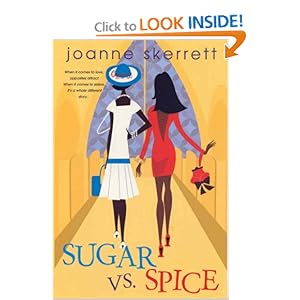
I’m going to go ahead and assume that you, dear readers, are like me in that you—sometimes, at least—judge books by their covers.  That’s precisely what drew me to Sugar vs. Spice , because in my experience, it is very rare to come across a contemporary fiction featuring a black female that contains not a single kinky sex scene (or any sex scene, for that matter).  Not that I have anything against that genre, but it’s uncommon nonetheless.  However, when I learned that Joan Skerrett ’s book was about Tari Shields, a short (like me), feisty (like I try to be), kickboxing/yoga fanatic (both of which I love) journalist (see “Aspirations” in my “About Me”) whose career and budding romance are brought to a screeching halt when she is diagnosed with breast cancer (the same disease my mother had 11 years ago and has thankfully recovered from), I was downright spooked.  Call me a narcissist, but how could I not have checked it out?

Tari’s wrestling matches not only with cancer, but with the pride and stubbornness that distanced her from her family and friends were all too relatable.  Her refusal to disclose her illness to her editor, potential boyfriend (whom I pictured had the face of Shemar Moore , but that's just a suggestion to sweeten the plot), and even her parents was met with my exasperated sighs, as I found myself telling her through gritted teeth to “just let them help you!” 

Easier said than done, of course.  Because black women—or any woman of color—must bear the brunt of two disenfranchised subcultures, which can result in the belief that asking for help or showing our vulnerability equates to weakness.  This touching novel (an easy read that goes well with a bar of dark chocolate…and maybe a couple Kleenex) taught me that it’s quite the opposite.  Anybody can refuse help to overcome obstacles.  It’s the ones who courageously extend their hands, who willingly acknowledge their vulnerability and let themselves be saved, who possess the true strength.